Title:
take a walk, hydrate well, calm down
Year:
2026
Dimensions each:
280cm x 225cm x 50cm
Material:
100% Cotton
EN (german below)
In her textile work “take a walk, hydrate well, calm down”, created specifically for the exhibition “On the Situation of Women in Family and Society”, Cooke explores the relationship between the body, illness, and the authority of institutions to define and interpret health.
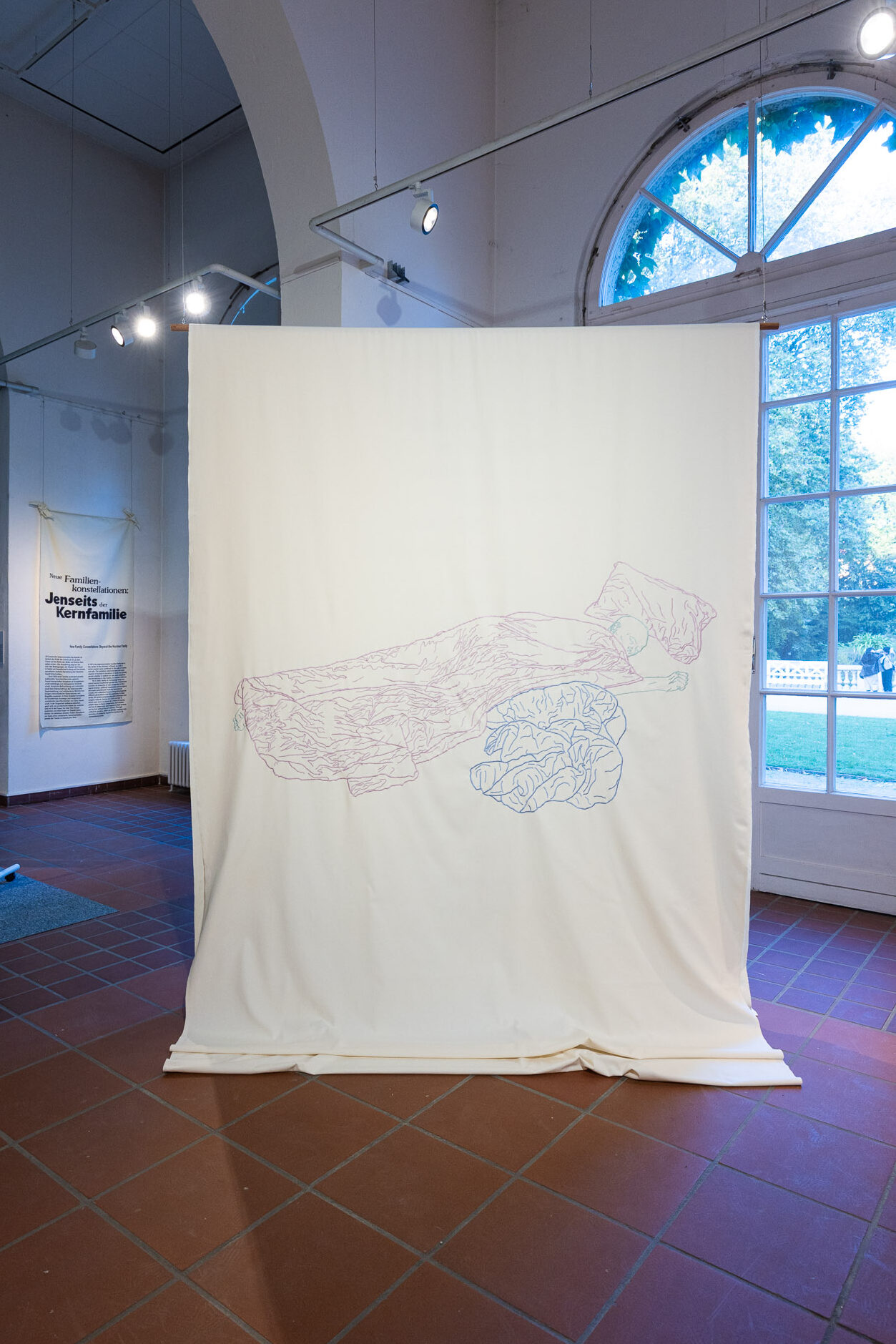
A large-scale piece of fabric hangs freely in the space, draped over a rod so that both its front and back are visible, allowing viewers to walk around it.
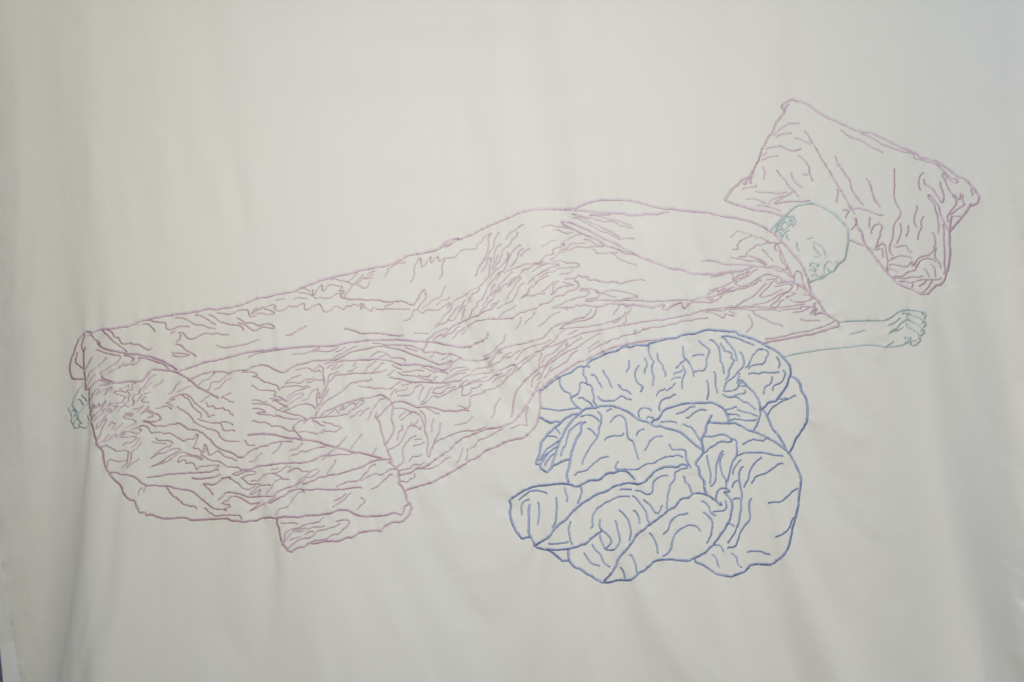
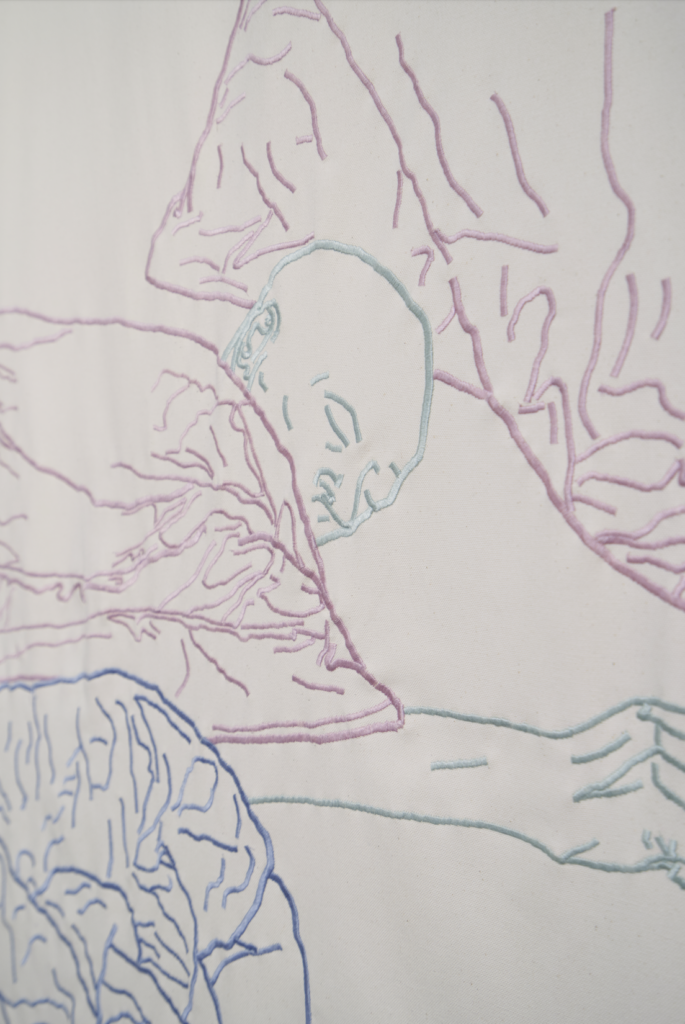
On one side, a figure is depicted, stitched using a sewing machine with a wide satin stitch. It is the artist herself, lying in bed during chemotherapy: flat on her stomach, beneath a duvet, her head shaved, one fist slightly clenched.
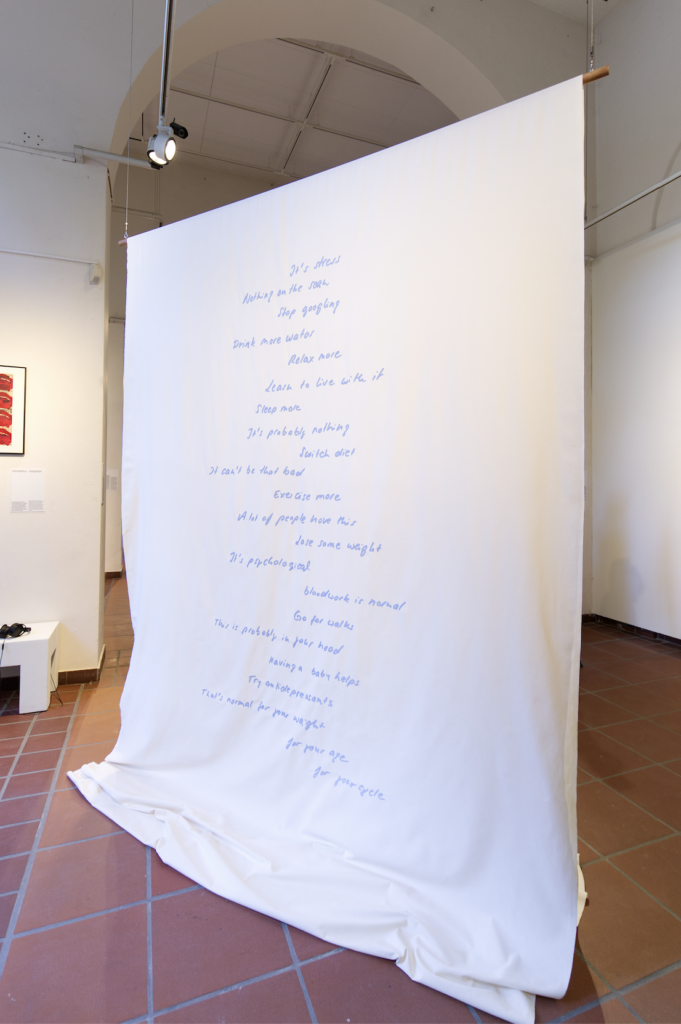
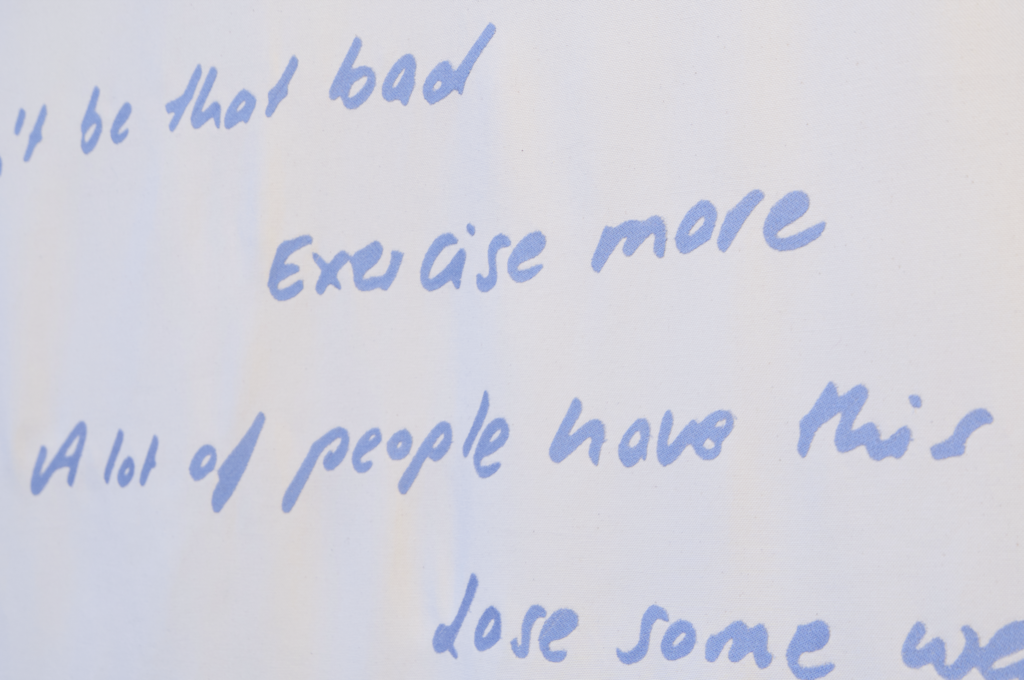
On the reverse side, Cooke has embroidered fragments of medical rhetoric phrases such as “Drink more water,” “It’s stress,” or “Go for a walk.” These are evasive maneuvers frequently employed in everyday medical practice, particularly when women’s symptoms cannot be easily categorized or are not taken seriously. Such “advice” reframes symptoms as mere lifestyle issues, effectively leaving patients to cope with their suffering alone.
This language has a long history. As cultural historian Elinor Cleghorn demonstrates in her book Unwell Women, the assumption that female suffering is imagined, exaggerated, or psychosomatic has persisted from antiquity to the present day ranging from the concept of a “wandering womb” and “hysteria” to the trivializing remarks that patients still encounter in doctors’ offices today. By translating this history into a textile medium, a material intimately connected to the body, Cooke intertwines the medical realm with the domestic sphere. In doing so, Cooke aligns herself with a long-standing visual tradition, that of the ailing woman in bed, stretching from 17th-century Dutch genre paintings, in which physicians notoriously misdiagnosed young female patients with “lovesickness,” to the depictions of sickbeds by artists like Munch or Schiele. Unlike in that tradition, however, it is the artist herself who directs the gaze here. Through her embroidery, she stitches the authority of interpretation back into the very materials that surround her.
DE
In ihrer für die Ausstellung neu angefertigten textilen Arbeit “take a walk, hydrate well, calm down” verhandelt Cooke das Verhältnis von Körper, Krankheit und institutioneller Deutungshoheit.
Ein großformatiges Tuch hängt frei im Raum, über eine Stange gelegt, sodass Vorder- und Rückseite gleichermaßen sichtbar werden und die Betrachter:innen es umschreiten können.
Auf der einen Seite ist mit der Nähmaschine, in breitem Satinstich gestickt, eine Person zu sehen. Die Künstlerin selbst, wie sie während der Chemotherapie im Bett liegt, flach auf dem Bauch, unter einer Bettdecke, mit Glatze, eine Faust leicht geballt.
Auf der Rückseite hat Cooke Fragmente ärztlicher Rhetorik eingestickt. Sätze wie “Drink more water”, “It’s stress”, oder “Go for a walk“. Ausweichmanöver, die im medizinischen Alltag besonders oft dann greifen, wenn die Beschwerden von Frauen nicht direkt einzuordnen sind oder nicht ernst genommen werden. Ratschläge, die Symptome in Lifestyle-Probleme übersetzen und Patient:innen mit ihrem Leiden allein lassen.
Diese Sprache hat eine lange Geschichte. Wie die Kulturhistorikerin Elinor Cleghorn in ihrem Buch “Die kranke Frau”rekonstruiert, zieht sich die Unterstellung, weibliches Leiden sei eingebildet, übertrieben oder psychosomatisch, von der Antike bis in die Gegenwart. Von der “wandernden Gebärmutter” über die “Hysterie” bis zu den bagatellisierenden Sätzen, die Patientinnen noch heute in Sprechzimmern hören. Cooke überträgt diese Geschichte in ein textiles, körpernahes Material und verschränkt so das Medizinische mit dem Häuslichen.
Cooke schreibt sich damit in eine lange Bildtradition der kranken Frau im Bett ein, von den holländischen Genrebildern des 17. Jahrhunderts, in denen Ärzte junge Patientinnen notorisch mit ‘Liebeskrankheit’ fehldiagnostizierten, bis zu Munchs oder Schieles Krankenbett-Darstellungen. Anders als in dieser Tradition ist es hier jedoch die Künstlerin selbst, die den Blick führt. Sie stickt die Deutungshoheit zurück in das Material, das sie umgibt.